
Altered Medical Records: What LNCs Need to Know
 You receive 3,000 pages of hospital records for a medical malpractice case. You organize them, build a chronology, identify significant clinical events, and start comparing the documentation with the allegations.
Everything seems to be there.
But are you looking at the whole story? Or is one hidden in the records?
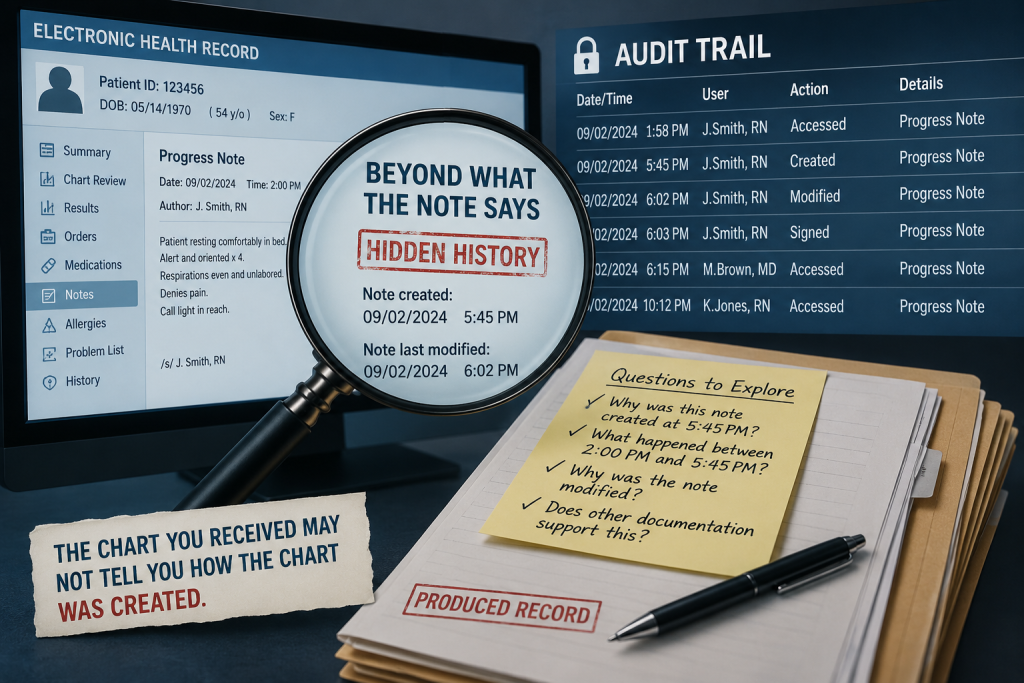
With electronic health records, the version of the chart produced for an attorney may tell you what the record says. It may not tell you when the information was entered, when it was changed, who changed it, or what activity occurred behind the scenes.
For a legal nurse consultant, that distinction can be significant in a case.
A Medical Record Is No Longer a Static Document
In the days of paper charts, alterations could sometimes be detected by forensically examining handwriting, different inks, erasures, or overwritten words. You may also detect missing pages, or entries appearing out of chronological sequence.
These are just some of the altered medical records I’ve seen:
- physician office records written on forms that did not exist at the time of the purported note
- hospital progress notes changed by a different provider with different handwriting
- a physician who inserted a diagnosis on a patient’s office note after he found out about the results of abnormal testing
- sections of the chart that were destroyed
- a nursing home administrator who testified that the missing medical records were eaten by a dog who came into his office
- a physical therapist who documented she gave PT to a patient who died a week earlier
- nursing home staff who documented they gave care to a resident – after she was transferred to a hospital
- a group of nursing home nurses who were asked to rewrite their notes after a resident pulled out her tracheotomy tube
Electronic health records changed the nature of the investigation, but not the potential for altered records.
A note can appear perfectly ordinary when viewed on the screen or printed as part of a medical record production. What you see is the finished product. The history behind that finished product may be much more revealing.
For example, suppose a nurse’s documentation states that a patient was assessed at 2:00 PM. At 2:30 PM, the patient experienced serious deterioration.
On its face, the 2:00 PM assessment may appear to establish the patient’s condition shortly before the event.
But what if the assessment wasn’t entered until 9:45 PM?
That does not automatically mean the record was altered improperly. Healthcare professionals frequently enter documentation after providing care, particularly during emergencies and periods of intense clinical activity.
But the timing creates a question worth investigating.
Or what if the original entry included abnormal vital signs at 2:00 PM, which were changed to normal ones at 9:45 PM?
Asking questions and using analytical abilities are when your clinical knowledge becomes particularly valuable. This is the skill that sets you apart from AI-assisted organization and summary of medical records.
Look Beyond What the Note Says
When reviewing a questionable record, think in terms of two timelines.
The first is the clinical timeline:
What happened to the patient, and when?
The second is the documentation timeline:
When was information actually entered, reviewed, edited, signed, or amended?
Those timelines may not match.
Imagine a physician’s note describing a detailed examination performed shortly before a patient’s condition deteriorated. The note fits neatly into the chronology.
Then an audit reveals that the note was created hours after the event.
That finding doesn’t prove fraud. But it changes the questions that you need to ask.
- Was the physician documenting an examination from memory?
- Was information added after the outcome was known?
- Does other documentation support the physician’s description?
- Do the nursing notes, vital signs, medication records, orders, laboratory results, and communications tell the same story?
This is where you can help an attorney recognize that a seemingly complete chart deserves further investigation.
When the Chart Looks a Little Too Good
Sometimes it isn’t an obvious inconsistency that should get your attention. It is documentation that suddenly becomes unusually thorough.
Suppose a nurse routinely writes brief assessments throughout a patient’s hospitalization. After an adverse event, however, the documentation for the hours immediately preceding it contains extensive descriptions of assessments, physician notifications, patient education, and interventions.
Why did the documentation pattern change?
Or perhaps several notes contain nearly identical descriptions of the patient’s condition even though the clinical data show deterioration.
- Did the staff copy and paste the data?
- Did the providers independently assess the patient?
- Did the staff add documentation later?
Again, none of these circumstances alone establishes that the staff intentionally altered the records. They identify areas requiring your closer examination.
The Audit Trail May Answer Questions the Printed Chart Cannot
An EHR audit trail can contain information about user activity within the patient’s electronic record. Depending on the system and the data produced, it may help identify when staff created, accessed, modified, signed, or supplemented documentation.
This creates another layer of case analysis.
An attorney may need to know not simply whether a critical laboratory value appears in the chart, but when a provider saw that result.
- A progress note may be dated Tuesday, but when was it actually created?
- Did staff make an addendum made before or after the adverse outcome?
- Did staff modify documentation after the patient was discharged?
- Did the staff make numerous entries after a significant incident?
- Who accessed the patient’s chart after the event?
These questions can help reconstruct what occurred both clinically and electronically.
The LNC’s Role: Recognize When the Story Doesn’t Fit
Legal nurse consultants do not need to label every altered medical record or documentation discrepancy as tampering or fraud. In fact, doing so can weaken our credibility.
Our job is to recognize patterns, inconsistencies, timing problems, and clinical contradictions that deserve additional investigation.
When reviewing a record, ask yourself:
- Does the documentation match the patient’s clinical condition?
- Do entries from different healthcare professionals support or contradict one another?
- Are there unexplained gaps during critical periods?
- Does documentation become markedly more detailed around an adverse event?
- Are there late entries, amendments, or addenda that warrant closer examination?
- Does the sequence of events make clinical sense?
- Would an audit trail help answer questions the produced chart cannot?
Your nursing background gives you something that a spreadsheet of audit data cannot provide: an understanding of what should have been happening at the bedside.
When that clinical story and the documentation story don’t line up, it may be time to look behind the chart.
Learn How Attorneys Investigate the Electronic Record
At the 14th LNC Success® Online Conference, September 9–11, 2026, you’ll hear directly from an attorney about chart audits and how they can be used to investigate altered medical records.
You’ll gain a clearer understanding of what may exist behind the medical record you routinely review—and why that information can matter in litigation.
If you analyze medical records for attorneys, this is an area you need to understand. The printed chart may be only one part of the evidence.
Join us September 9–11 for the LNC Success® Online Conference and learn how chart audits can reveal the history behind the medical record. Register here.