
How to Edit Your Report
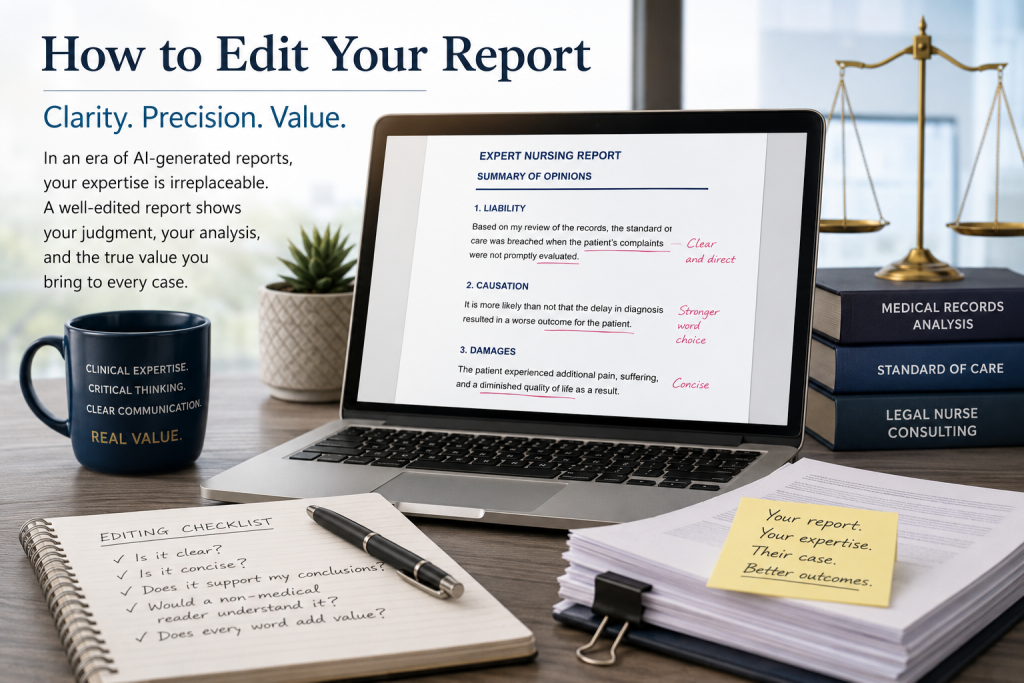
You have spent hours reviewing medical records, identifying key facts, and developing your analysis. You have written a chronology, medical summary, screening report, or expert fact witness report. Now comes a step that many legal nurse consultants rush through: editing.
In today’s environment, attorneys have access to AI tools that can organize records and generate reports in minutes. That means your report must do more than summarize information. It must demonstrate your thinking, judgment, and ability to communicate clearly.
The quality of your report reflects the quality of your thinking and analysis.
A Report That Missed the Mark
An experienced legal nurse consultant sent a report to an attorney after reviewing a complex case involving a delayed diagnosis. She felt confident about her work. The report contained the right facts, the correct dates, and a thorough discussion of the medical liability and causation issues.
A few days later, the attorney called.
“I know you worked hard on this,” he said, “but I had trouble following your analysis.”
The LNC reread her report and immediately saw the problem. She had become so immersed in the records that she assumed the attorney would make the same connections she saw. Paragraphs stretched for half a page. She used medical terminology without explaining it. Her key conclusions were buried in the middle of dense text.
The facts were accurate, but her writing did not help the attorney understand the case.
She sat down to edit the report. After revising the report, shortening paragraphs, simplifying terminology, and moving her conclusions to the beginning of the report, she resubmitted it.
The attorney’s response was immediate.
“Now I can see exactly what happened.”
The difference was not the LNC’s medical knowledge. She did not do any further research on the issues when she sat down to rewrite the report.
The difference was the editing.
And the LNC gained perspective on what to do on other reports. She could not bill for her learning curve, and for the time she spent reworking the report. “Do it right the first time”, she thought.
You’ve Worked Hard and Lost Perspective
This happens to every writer: You become immersed in the case. Even when you’re away from your desk, you’re thinking about the records and mentally reorganizing events.
When you finish writing, resist the temptation to immediately edit. Give yourself some distance from the report. Even a few hours can help. A day is better if your deadline permits.
Distance allows you to return to the report as a reader rather than as the writer.
Repeat: “This Is Not Me”
Many writers become attached to their words. You may hesitate to remove a paragraph because you spent twenty minutes writing it. You may defend a complicated sentence because it sounds impressive.
Remember that your report is a tool.
The attorney cares whether the paragraph helps explain the case.
Be Ruthless
Approach your report as if you are the attorney receiving it.
Ask yourself:
- Is this point clear?
- Does this paragraph support my conclusion?
- Am I repeating information?
- Can this sentence be shorter?
- Would a non-medical reader understand this term?
Many legal nurse consultants find it helpful to read reports aloud. Reading forces you to slow down and often reveals awkward phrasing, missing words, and confusing transitions.
Write for Busy Attorneys
Attorneys are often reviewing reports between meetings, depositions, hearings, and client calls.
They want reports that are:
- Clear
- Organized
- Concise
- Easy to understand
If you use highly technical medical terminology or abbreviations, explain them in language a non-clinician can understand.
Keep It Focused
One of the most common editing mistakes is including information that does not advance the analysis.
Every fact should have a purpose.
Every paragraph should support your conclusions.
Use Short Paragraphs When You Edit Your Report
Large blocks of text discourage reading.
Short paragraphs create visual breaks and help attorneys absorb information more easily. Have no more than 3-4 lines in a paragraph.
I prefer paragraphs that focus on a single idea. When a new idea begins, start a new paragraph.
Choose Strong Words
Strong writing creates confidence.
Instead of writing:
“The records appear to suggest…”
Consider whether the evidence allows you to write:
“The records indicate…”
Or:
“The records support the conclusion that…”
Be precise. Be direct.
Why Editing Matters More Than Ever
Artificial intelligence can organize records and produce summaries.
What it cannot do is replace your clinical judgment, your understanding of the nuances of patient care, or your ability to recognize significance within thousands of pages of records.
Your report is where those skills become visible.
A carefully edited report demonstrates professionalism. It shows analytical thinking. It helps attorneys trust your conclusions.
A poorly edited report, even one based on excellent analysis, can obscure your value.
The more competition there is from technology, the more important it becomes for legal nurse consultants to produce reports that reflect their expertise.
The stronger your editing skills, the stronger your reports become.
And stronger reports help attorneys recognize something no software can replicate: the insight and judgment of an experienced legal nurse consultant. Edit your report to emphasize the value of your analysis. Your LNC success depends on this skill.
Join us for the 5th volume of Medical Record Analysis, now getting underway. Sign up to be a published author using this link: http://LNC.tips/MRA5

Pat Iyer is president of The Pat Iyer Group, which develops resources to assist LNCs in obtaining more clients, making more money, and achieving their business goals and dreams.
Have you heard the most recent podcasts on Legal Nurse Podcast? The show is in its 10th year, putting it in the top 1% of all podcasts for its longevity. Watch our podcast on YouTube at http://LNC.tips/YouTube.
Join our Facebook group, LNC Business Growth Circle, to be part of our LNC community.
Pat’s related websites include the podcasts broadcast at podcast.legalnursebusiness.com, and writing tips supplied at http://patiyer.com.