
How LNCs Can Use Educational Content to Attract Attorneys
 Is this you? LNCs often believe every piece of marketing content should promote their services. It is easy to understand why. You want attorneys to know what you do, why you are qualified, and how you can help their cases. This is the heart of how to attract attorneys.
If you are connected to LNCs on LinkedIn, you’ve seen these posts. They are purely promotional. But there is a problem with content that constantly promotes services.
Attorneys are busy. They receive emails, LinkedIn messages, newsletters, and marketing materials every day from experts competing for attention. If every blog post sounds like an advertisement, attorneys may quickly tune it out.
Understanding the difference between educational writing and promotional writing can improve how attorneys respond to your content and how they view your expertise.
Promotional Writing to Attract Attorneys
Promotional writing focuses primarily on your business. It highlights credentials, services, certifications, years of experience, and reasons attorneys should hire you. There is certainly a place for that type of writing. Your website service pages, brochures, and professional profile should clearly explain what you offer.
The issue arises when all of your content sounds promotional.
Educational Writing to Attract Attorneys
Educational writing takes a different approach.
Educational content teaches attorneys something useful. It explains medical issues, clarifies confusing documentation, discusses case analysis strategies, or points out areas that are frequently overlooked in records. We have a plethora of topics that would interest attorneys.
Instead of repeatedly saying, “Hire me,” educational writing demonstrates your knowledge through practical information.
That distinction matters.
Attorneys hire legal nurse consultants they trust. One of the fastest ways to build that trust is by consistently sharing information that helps attorneys better understand medical issues affecting their cases.
For example, compare these two blog titles:
Promotional approach:
“How an LNC can help you”
Educational approach:
“Five Medical Conditions That Can Mimic Traumatic Injuries in Personal Injury Cases.”
The second topic immediately provides value. An attorney reading that article may begin thinking differently about causation, preexisting conditions, or medical defenses.
The legal nurse consultant has demonstrated expertise without sounding sales-focused.
Educational content helps attorneys see how you think. That is powerful because many attorneys struggle with medical terminology, conflicting records, complicated timelines, and unclear causation issues. When your content explains these topics clearly, attorneys begin viewing you as a reliable resource.
Educational content can also reduce uncertainty.
Attorneys often worry about missing something important in the records. They may not fully understand the significance of a delayed diagnosis, medication interaction, pressure injury progression, or inconsistencies in charting. This fear gives them nightmares.
Your educational content can help them recognize those issues before they become case problems.
Consider the difference between these promotional and educational topics:
Promotional:
“Why You Should Hire Me as Your Legal Nurse Consultant”
Educational:
“How Copy-and-Paste Charting Can Affect the Credibility of Medical Records”
Promotional:
“I Analyze Medical Malpractice Cases”
Educational:
“Seven Red Flags in Emergency Department Records Attorneys Should Not Ignore”
Which article would an attorney be more likely to read and share?
Educational content creates far more engagement because it addresses attorney concerns directly.
One misconception legal nurse consultants sometimes have is believing educational writing should never mention services. That is not true. Your content can absolutely guide attorneys toward contacting you.
The key is balance.
Most of the article should focus on helping the attorney understand a problem, risk, or strategy. A short call to action at the end is usually enough.
For example, here is a soft call to action:
“If you are handling a case involving questionable documentation or complex medical issues, I help attorneys identify inconsistencies, clarify timelines, and analyze standards of care.”
That feels informative instead of overly promotional.
Educational writing also gives you a nearly endless supply of blog topics or LinkedIn posts.
Think about the questions attorneys ask you:
- What records matter most in this type of case?
- Is this injury consistent with the accident?
- What should I look for in the timeline?
- Are these symptoms related to the event?
- Could this complication have been prevented?
- What does this medication indicate?
- Why are these records inconsistent?
Every question can become a blog or LinkedIn post.
Educational content positions you as a knowledgeable guide rather than an LNC simply advertising their services.
It also helps your content perform better online. Attorneys searching for information are more likely to find and read articles answering specific medical-legal questions than general promotional content.
For example, consider the key words in these topics:
- “Understanding Sepsis Documentation in Hospital Records”
- “How to Identify Altered Medical Records”
- “Why Falls in Nursing Homes Are Often More Complex Than They Appear”
- “The Role of Medical Timelines in Catastrophic Injury Cases”
These topics attract attorneys searching for insight, not advertisements.
Educational writing also has long-term value. A strong article can continue bringing traffic to your website for years. Over time, your collection of educational content becomes proof of your experience and perspective.
Attorneys who regularly read your articles may begin to feel they already know your approach before they ever contact you.
That familiarity builds trust.
Some legal nurse consultants worry that sharing too much information will reduce the need for their services. In reality, educational content often increases inquiries because attorneys realize how much there is to understand.
A blog post may help an attorney recognize an issue, but still leave them wanting professional assistance analyzing the records in detail.
Your educational content opens the door to those conversations.
 If your current marketing feels repetitive or overly promotional, review your content with these questions in mind:
- Does this article teach attorneys something useful?
- Would this help an attorney understand a medical issue more clearly?
- Am I explaining real case-related problems?
- Does this demonstrate how I analyze cases?
- Would an attorney forward this article to a colleague?
The legal nurse consultants who attract attention are often the ones who consistently educate attorneys rather than constantly promoting themselves.
Educational writing builds credibility one article at a time.
And credibility is what turns readers into attorney clients.
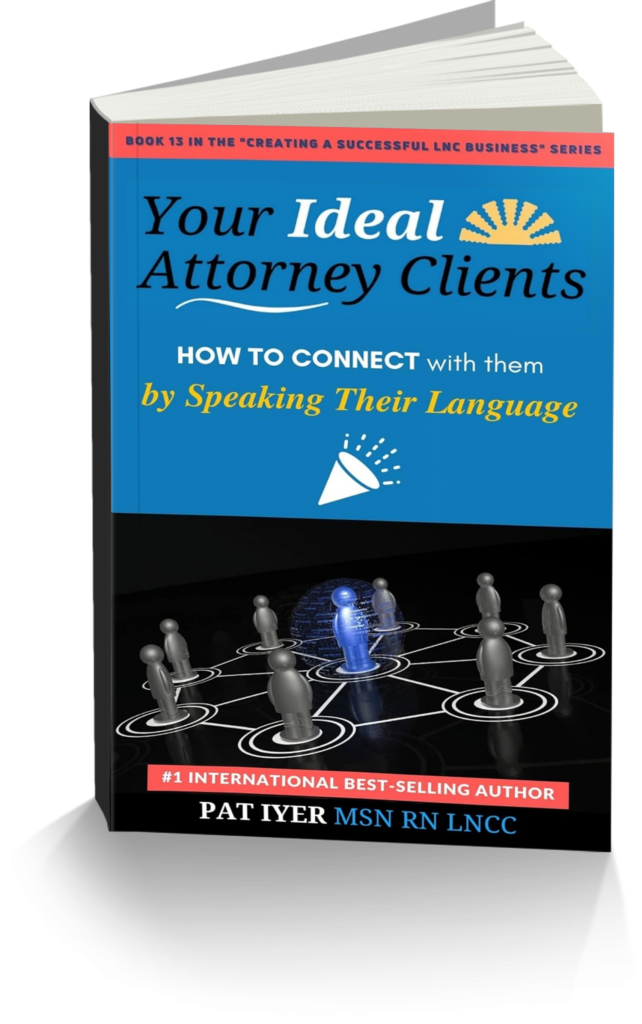
I explore this topic more deeply in my book, Your Ideal Attorney Clients, How to Connect with Them by Speaking Their Language. Order it here.
 Pat Iyer MSN RN LNCC is president of The Pat Iyer Group. She develops resources to assist LNCs in obtaining more clients, making more money, and achieving their business goals and dreams.
Have you heard the most recent podcasts on Legal Nurse Podcast? The show is in its 10th year, putting it in the top 1% of all podcasts for its longevity. Watch our podcast on YouTube at http://LNC.tips/YouTube.
Join our Facebook group, LNC Business Growth Circle, to be part of our LNC community.
Pat’s related websites include the podcasts broadcast at podcast.legalnursebusiness.com, and writing tips supplied at patiyer.com. Pat’s latest books are AI-Powered Video for LNCs: A Guide to Visibility and Growth book and workbook. Order at this link.
Get all of Pat’s content in one place by downloading the mobile app, Expert Edu at www.legalnursebusiness.com/expertedu. Watch videos, listen to podcasts, read blogs, watch online courses and training, and more.